How many times should you call a lead before giving up?
Bassel, Founder of TalaLevel ·
Call at least four times. On our floor a first call got a person 6.2% of the time, and the second, third and fourth calls to leads we still hadn’t reached got 6.4%, 5.5% and 6.9%. Calling back took us from 6.2% of leads reached to 10.7%. From the fifth call it fell to about 3%.
It’s easy to treat a lead who didn’t pick up as a lead who isn’t interested. We counted our own calls to see if that’s true. It isn’t, and we found out we’d been leaving more than half our list behind after a single call.
We run a small outbound floor that calls business owners across the US. In the past three months we made over 20,000 calls. The percentages in this post come from the ones our own system recorded and transcribed, from September to early November 2026. We wanted one number out of them: when a lead hasn’t picked up yet, what are the odds that the next call gets them?
The short answer
Call four times. For us the second, third and fourth calls each got a person about as often as the first one did. From the fifth call it dropped off.
How we counted
A call counts here when a person answered it. Every call we make is transcribed and marked with what picked up, so a voicemail greeting or a call screener doesn’t count, however long the call ran. We used to count any call of 30 seconds or more, and that turned out to be wrong by about half. That story is in our post on the best time to call.
Everything below is about leads we had not reached yet. Once a person answers, that lead drops out of the count.
Call by call
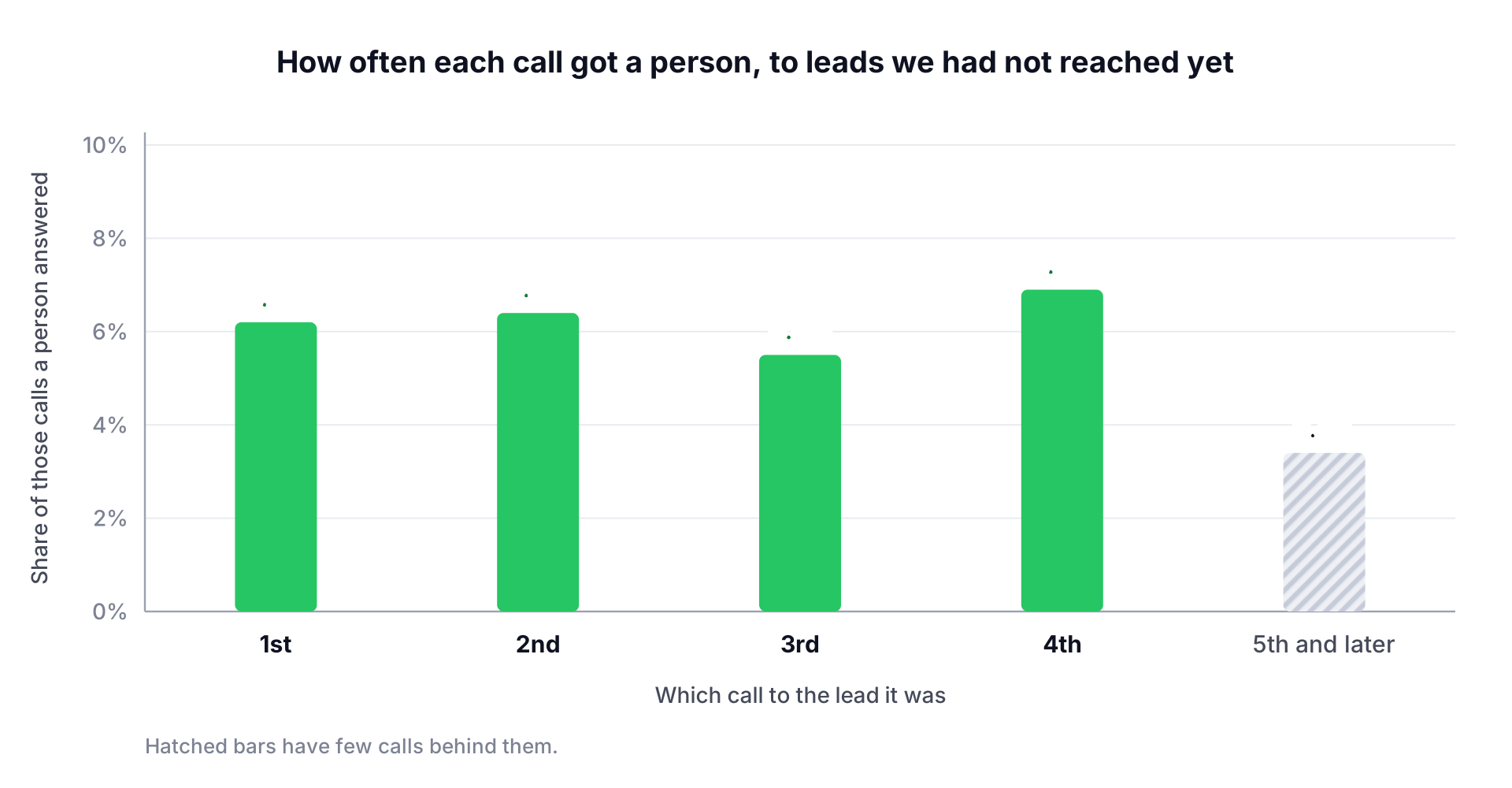
| Call to the lead | A person answered |
|---|---|
| 1st | 6.2% |
| 2nd | 6.4% |
| 3rd | 5.5% |
| 4th | 6.9% |
| 5th and later | 3.4% |
The second call is the row we look at most. 6.4% against 6.2%. A lead who didn’t pick up the first time answered the second call just as often as a lead we’d never called. We had assumed that not picking up told us something about the lead, and for the first four calls it told us nothing.
The third and fourth calls held up too, at 5.5% and 6.9%. We wouldn’t read anything into the fourth being the highest. Far fewer leads got four calls than got one, so those rows move around more.
From the fifth call on it was 3.4%, and very few leads ever got that many, so that’s the weakest row in the table.
How it adds up
Each call on its own reaches about 6 in 100. What we care about is how many leads we’ve talked to in the end.
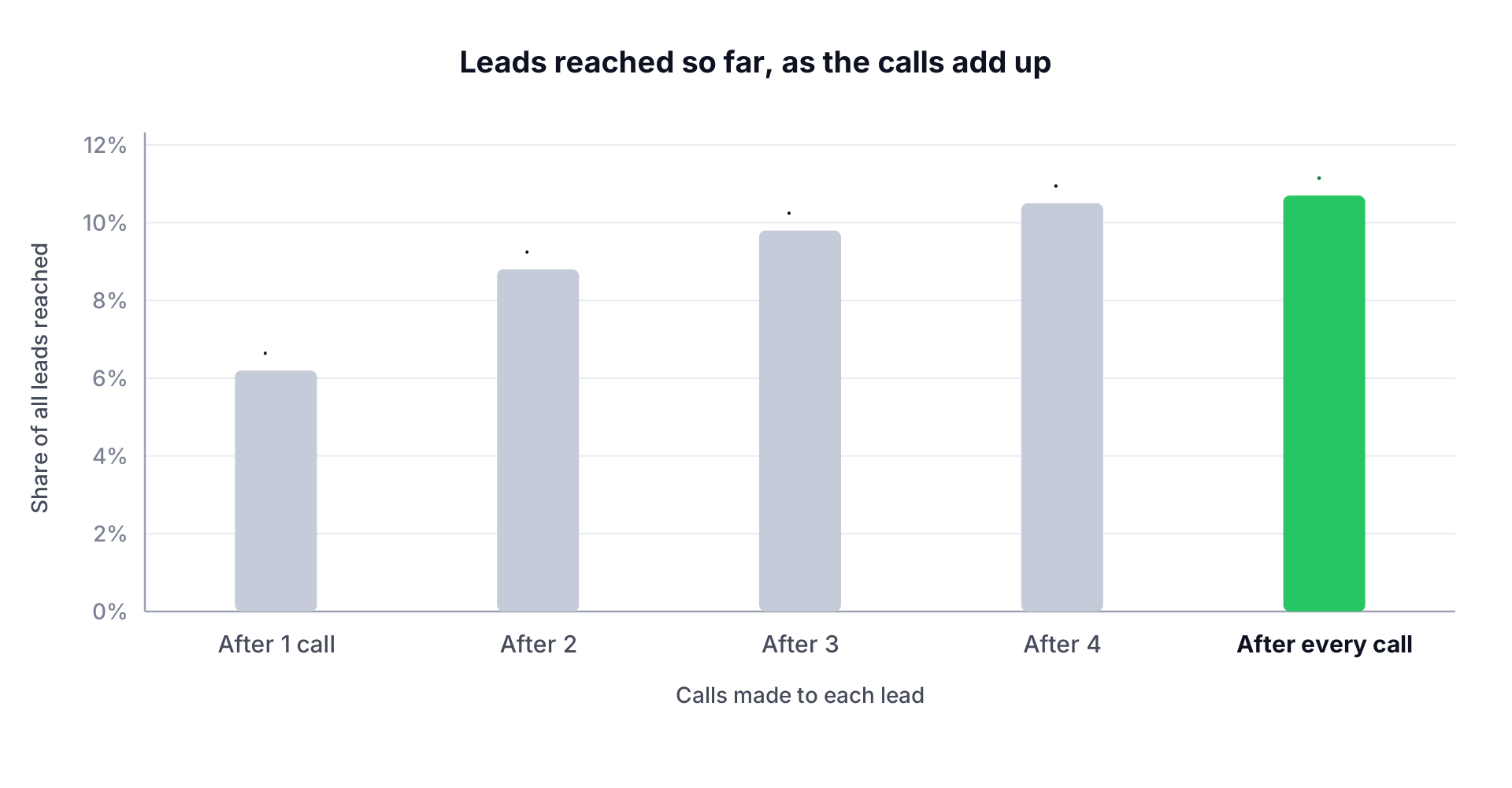
One call each would have reached 6.2% of our leads. With the calls we made after that we got to 10.7%. That’s 73% more people from the same list, without buying a single new lead.
Here is which call first got the person, for everyone we reached:
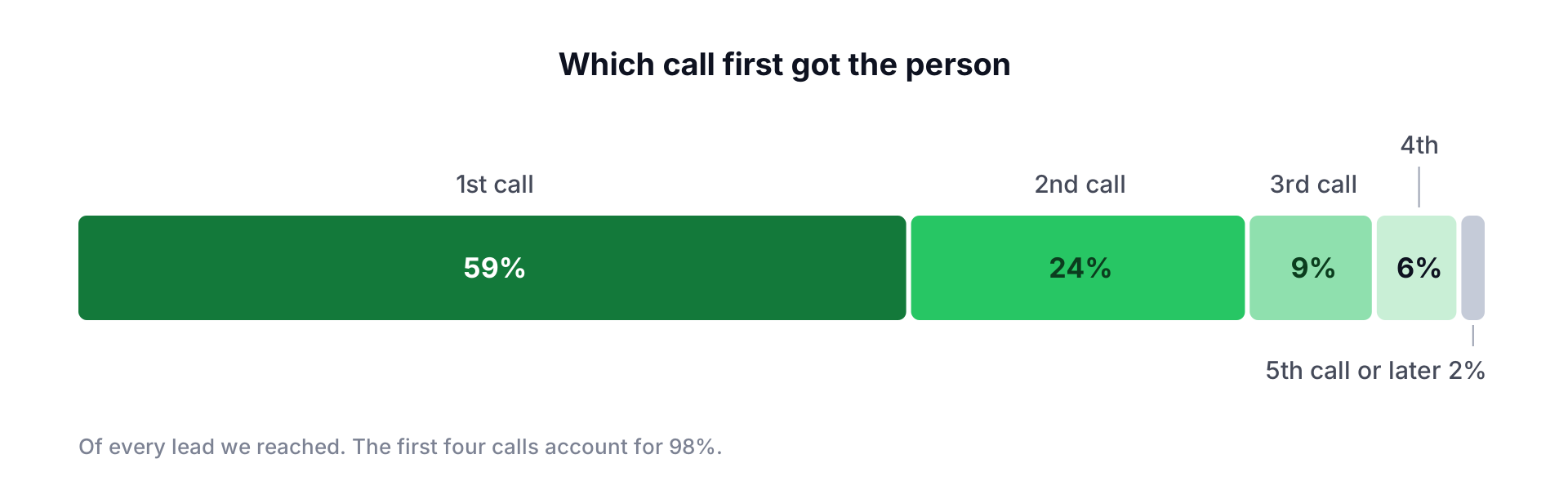
Four in ten of the people we talked to didn’t answer the first time we called.
The mistake
When we looked at how many calls each lead had been given, more than half of them had got exactly one call that nobody answered, and then we never called them again.
Nobody decided to skip them. They just never came back to the top of the list, because there were always new leads above them.
If we’d called those leads once more, at the 6.4% a second call was getting, we’d have reached about a third more people than we reached in all that time. That was the most expensive thing we found, and it was sitting in a list we’d already paid for.
How long to wait between calls
We expected a sweet spot, something like “wait two days.” We didn’t find one.
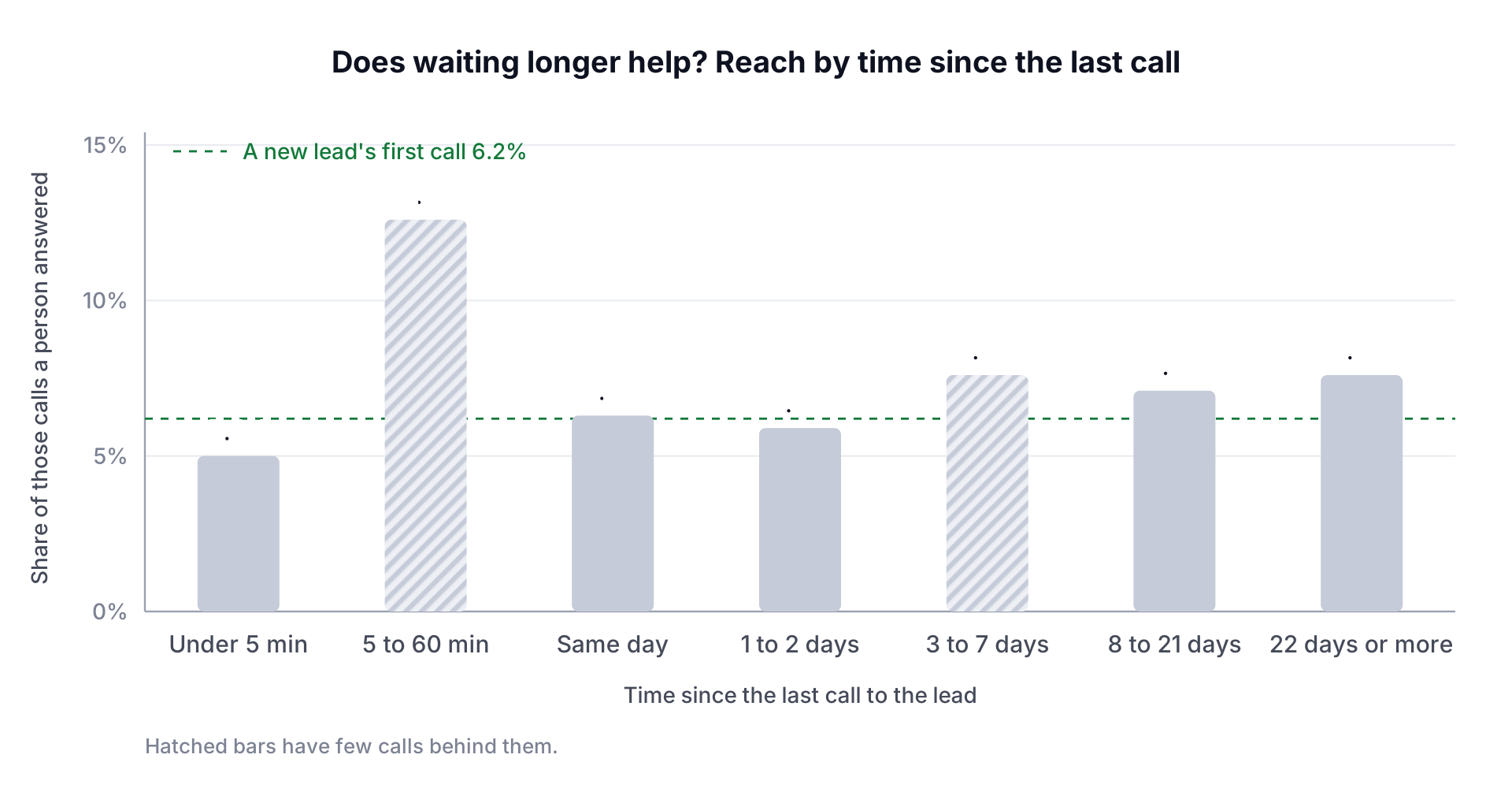
| Time since the last call | A person answered |
|---|---|
| Under 5 minutes | 5.0% |
| 5 to 60 minutes | 12.6% |
| Later the same day | 6.3% |
| 1 to 2 days | 5.9% |
| 3 to 7 days | 7.6% |
| 8 to 21 days | 7.1% |
| 22 days or more | 7.6% |
The row we find most useful is the last one. A lead we couldn’t reach three weeks or more ago answered 7.6% of the time, which is a little better than a brand new lead at 6.2%. An old list of no-answers isn’t a dead list. For us it was as good as a new one.
Calls made within five minutes are mostly the dialer trying the lead’s next number straight away, and those got a person 5.0% of the time. The 5-to-60-minute row looks great at 12.6%, but it’s the thinnest row here, so we’re not building anything on it.
Does the time of the second call matter?
A common piece of advice is to make the second call at a different time of day from the first. We checked. When the second call came at a different part of the day, a person answered 8.2% of the time. When it came at the same part of the day, 7.1%. That’s too close to call on the number of calls we have, so we don’t plan around it. It fits what we found about the best hour to call, which is that for us the hour barely mattered.
Try the other numbers
Many of our leads come with more than one phone number.
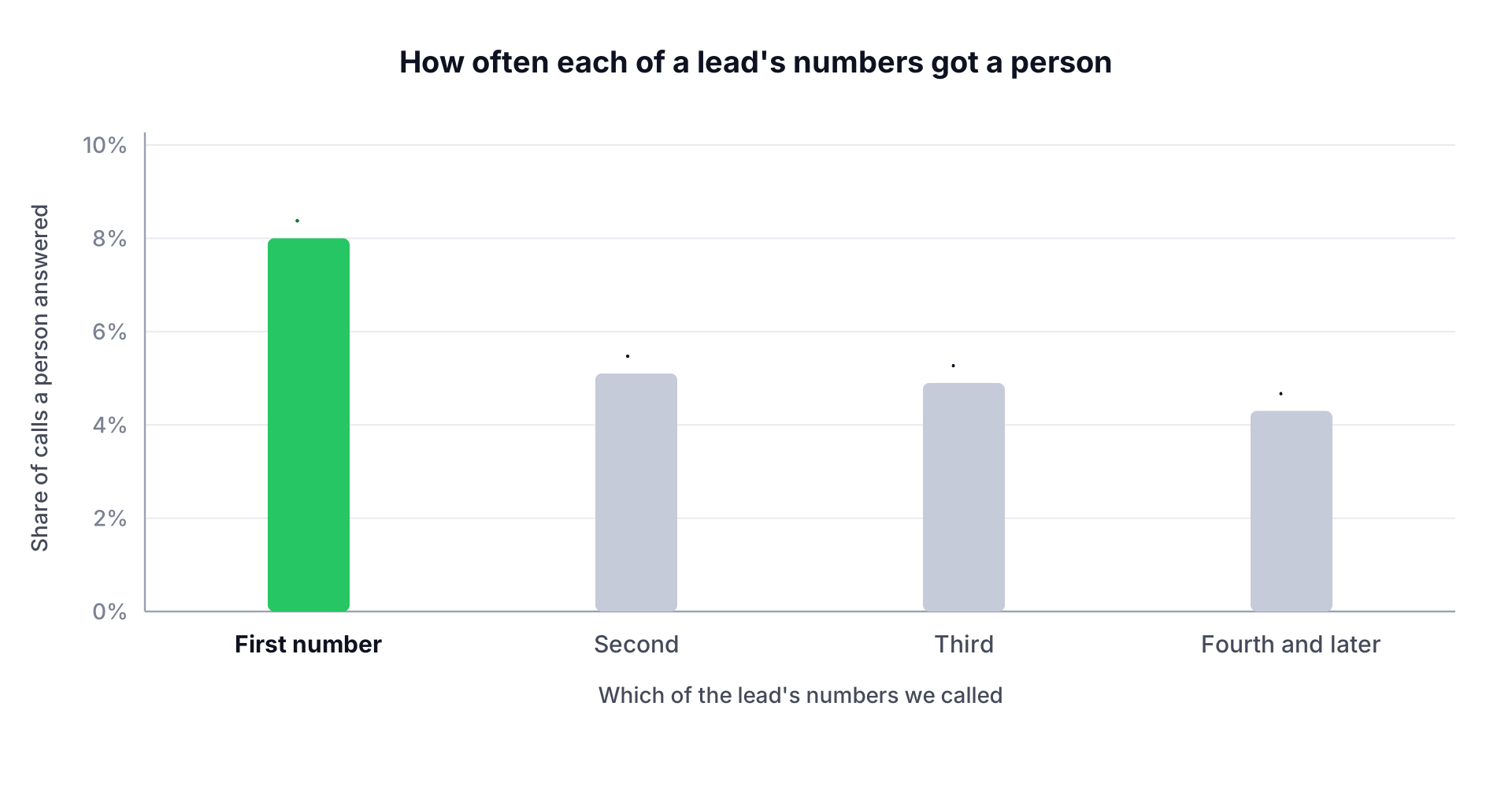
The first number on a lead got a person 8.0% of the time, the second 5.1% and the third 4.9%. Each one is weaker than the one before, but they add up. More than one in five of the people we reached answered on a second or later number. If you only ever dial the first number on the lead, that’s a fifth of your conversations you never have.
Will they call back?
We wondered if all of this was needed, or if a lead who sees a missed call just rings back.
Mostly they don’t. About 3 in 100 of the leads we called ever rang us back. Of the ones who did, half rang within the hour and two thirds the same day. So if a lead hasn’t called back by the next morning, they almost certainly won’t, and the only way to talk to them is to call again.
A cadence you can copy
This is the cadence these numbers point to. It needs a list and a way to sort it, and nothing else.
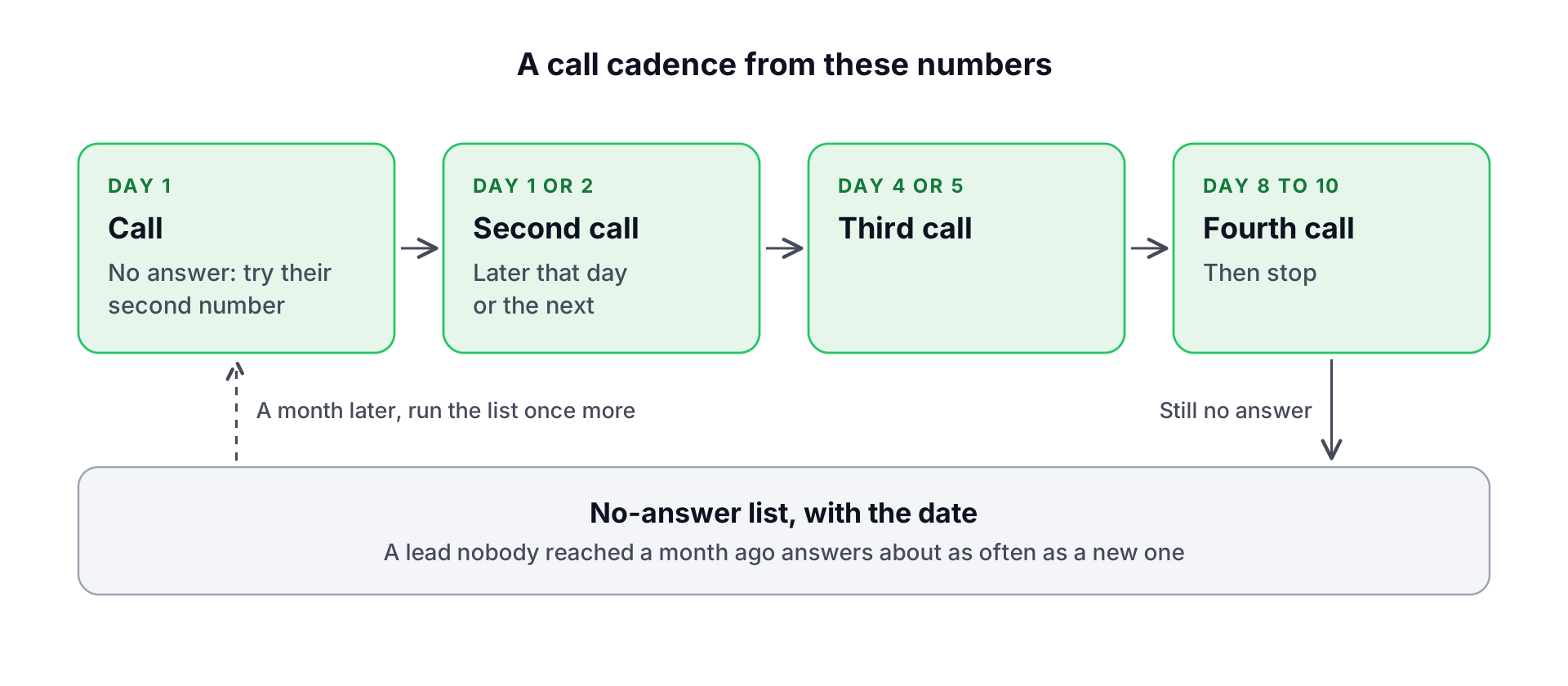
- Day 1: call. No answer, try their other numbers straight away.
- Day 1 or 2: second call.
- Day 4 or 5: third call.
- Day 8 to 10: fourth call.
- Stop. Put the lead on a list of no-answers with the date.
- A month later: run that no-answer list once more from the top.
Before any of it, sort the day’s list so yesterday’s no-answers come first, ahead of the new leads. That one change is what fixes the mistake above.
The exact days aren’t the important part. We didn’t find a gap that worked better than another. What matters is that the lead gets four calls and then a fifth a month later, and doesn’t get dropped after one.
Where these numbers are weak
This is one floor and one kind of lead, over about ten weeks of transcribed calls. What answered each call was marked from its transcript by software, and it will have got some wrong.
The first and second rows have the most calls behind them, and those are the ones we’d bet on. The leads that got a fourth or fifth call weren’t picked at random. They were often the ones a rep thought were worth another try, so those rows may flatter the later calls. And a lead’s first number is usually the best one on file, which is part of why second calls to the same number did well.
The dialer we built does the dull part of this for us. It tries each number on a lead in turn. That’s on the power dialer page if you want to see it.
Questions
- How many times should you call a lead before giving up?
- At least four. On our floor each of the first four calls to a lead we hadn’t reached got a person about 6% of the time: 6.2%, 6.4%, 5.5% and 6.9%. From the fifth call on it was about 3%, on few calls.
- Is a second call worth it if the lead didn’t answer the first?
- Yes. A second call to a lead who hadn’t picked up got a person 6.4% of the time, against 6.2% for a first call. It is as good as calling a new lead.
- How long should you wait before calling a lead again?
- It mattered less than we expected. Later the same day got a person 6.3% of the time, one to two days later 5.9%, and more than three weeks later 7.6%. A lead who didn’t answer a month ago was as likely to answer as a new one.
- What share of leads are reached on the first call?
- 59% of the people we reached answered the first call. 24% answered the second, 9% the third and 6% the fourth. The first four calls found 98% of them.
- Should you try a lead’s other phone numbers?
- Yes. More than one in five of the people we reached answered on a second or later number. The first number got a person 8.0% of the time and the second 5.1%.
- Do leads call back if you don’t reach them?
- Rarely. About 3 in 100 of the leads we called ever rang us back. Of those who did, half rang within the hour.
Keep reading
The sales CRM that calls, texts and follows up.From $47 a seat a month · Cancel anytime